


HVLS Fans
What is Gearbox HVLS Fan
Gearbox HVLS (High Volume Low Speed) Fan is a type of ceiling fan used in large commercial and industrial spaces. It is designed to move large volumes of air at a low speed, making it energy-efficient and effective in creating a comfortable and productive environment. The gearbox refers to its advanced gear system that enables more efficient and quieter operation. These fans are typically used in areas such as warehouses, factories, airplane hangars, gymnasiums, and other large indoor spaces.
-
![OPTFANS Giant Ceiling Fans Gym HVLS PMSM FANS For Warehouse]()
OPTFANS Giant Ceiling Fans Gym HVLS PMSM FANS For Warehouse
OPTFANS Giant Ceiling Fans Gym HVLS PMSM FANS for Warehouse
-
![OPTFANS Large Wall-mounted Fans Big Wall Fans]()
-
![OPTFANS Big Ceiling PMSM HVLS Fans For Large Space]()
OPTFANS Big Ceiling PMSM HVLS Fans For Large Space
OPTFANS Big Ceiling PMSM HVLS Fans for Large Space
-
![OPTFANS Giant Fans Large Industrial HVLS PMSM Fans For Outdoor]()
OPTFANS Giant Fans Large Industrial HVLS PMSM Fans For Outdoor
PMSM fans operate at a high efficiency due to the elimination of rotor copper
-
![OPTFANS HVLS Large Industrial DC Fan Big Fans]()
OPTFANS HVLS Large Industrial DC Fan Big Fans
Suzhou Optimal Machinery Co.,Ltd (OPTFAN)established in 2007, is the pioneer of
-
![HVLS Industrial Big Free Maintenance Ceiling Fan]()
HVLS Industrial Big Free Maintenance Ceiling Fan
Suzhou Optimal Machinery Co.,Ltd (OPTFAN)established in 2007, is the pioneer of
-
![HVLS Energy Saving Industrial Ceiling Fans]()
HVLS Energy Saving Industrial Ceiling Fans
Suzhou Optimal Machinery Co.,Ltd (OPTFAN)established in 2007, is the pioneer of
-
![Giant HVLS Industrial Ceiling Fans For Church]()
Giant HVLS Industrial Ceiling Fans For Church
Suzhou Optimal Machinery Co.,Ltd (OPTFAN)established in 2007, is the pioneer of
-
![OPTFANS BIG Mobile Floor Fans Portable Fans For Gymnasium]()
-
![2M Big Wall Mount Fans Energy-saving Fans]()
2M Big Wall Mount Fans Energy-saving Fans
Suzhou Optimal Machinery Co.,Ltd (OPTFAN)established in 2007, is the pioneer of
-
![OPTFANS Large Industrial Fans With PMSM Motor]()
-
![OPTFANS HVLS Large Industrial Ceiling Fans for Warehouse]()
OPTFANS HVLS Large Industrial Ceiling Fans for Warehouse
Main motor: Germany NORD. Blade quantity: 6.. Warranty: 3 years. Noise level:


Improved air circulation
HVLS fans are designed to move large volumes of air at low speeds, which creates a gentle yet effective breeze. This breeze helps to circulate air within the warehouse, which can be particularly important in large, open spaces where air can become stagnant. Improved air circulation can help to reduce humidity, eliminate hot spots and prevent the buildup of fumes and dust, all of which can improve the overall air quality of the warehouse.
Increased energy efficiency
HVLS warehouse fans are typically larger and more efficient than traditional highspeed fans. They operate at low speeds, consuming less energy while still providing effective air movement. This can result in significant energy savings, particularly in large warehouses where multiple fans are needed. In addition, they're often equipped with HVLS fan controls that allow them to operate only when and where they're needed, further reducing energy consumption.
Reduced cooling costs
In addition to improving air circulation, industrial warehouse ceiling fans can also help to reduce cooling costs. By providing a gentle breeze, HVLS fans can create a wind-chill effect that helps to lower the perceived temperature in the warehouse.
Improved employee comfort & productivity
When employees are working in a comfortable environment, they're far more likely to be productive and engaged. Industrial-size fans can help to create a more comfortable work environment by improving air circulation, reducing the perceived temperature and eliminating hot spots. This can result in fewer complaints from employees about the temperature or air quality and reduce absenteeism due to heat-related illnesses.
Better air quality
In warehouses, there may be high concentrations of dust, fumes and other airborne contaminants that could be harmful to your employees' health. Industrial-size fans can help to reduce the buildup of contaminants by circulating air and preventing stagnant air pockets from forming. This improves the overall air quality of the warehouse and creates a safer, healthier work environment for employees. In addition, improved air quality can also help to reduce the risk of product contamination, which can be particularly important in food storage warehouses.
Why Choose us
Experienced team
Our team comprises professional and experienced individuals who possess the necessary skills to handle and deliver your project with a top-rated result.
We always deliver on time
We genuinely understand the value of time in business and hence adhere to time and deliver all projects on time to our customers.
Customer satisfaction
We place customer satisfaction at the core of our operations. We aim to deliver services that exceed our customer's expectations and earn their trust.
Professionalism
Our company is committed to providing top-notch services to our clients. We have a team of highly skilled professionals who are trained to deliver quality services.
Experience
Our company has years of experience in the industry, which has enabled us to build a solid reputation for ourselves. We have worked with various clients and delivered successful outcomes.
Quality
Our top priority is to provide high-quality work that meets and surpasses your expectations.
HVLS Industrial Ceiling Fan Size
6 to 10 feet The smallest options of HVLS fans are ideal for smaller spaces, such as homes, offices, and small businesses.
10 to 18 feet Mid-size fans can help manage the comfort level of gyms, schools, restaurants, and multipurpose rooms.
18 to 24 feet The largest models of HVLS fans are used in spaces such as warehouses, distribution centers, aircraft hangers, and manufacturing facilities.
Three Factors Are Key in Determining The Best HVLS Fan Size For Your Space
Ceiling height
If you have a large open warehouse, your facility is a good candidate for an HVLS fan – more specifically, an entire fleet of them. Properly spaced HVLS fans provide the best coverage for your working environment. If you want to install fans, but your ceiling height is considerably lower, you'll benefit from more targeted industrial air circulators designed for your specific work environment.


Square footage
This measurement, combined with your ceiling height, gives you the total space you need to ventilate. To determine the square footage of your space, multiply the room's width by its length.
Airflow requirements
This measurement, combined with your ceiling height, gives you the total space you need to ventilate. To determine the square footage of your space, multiply the room's width by its length.
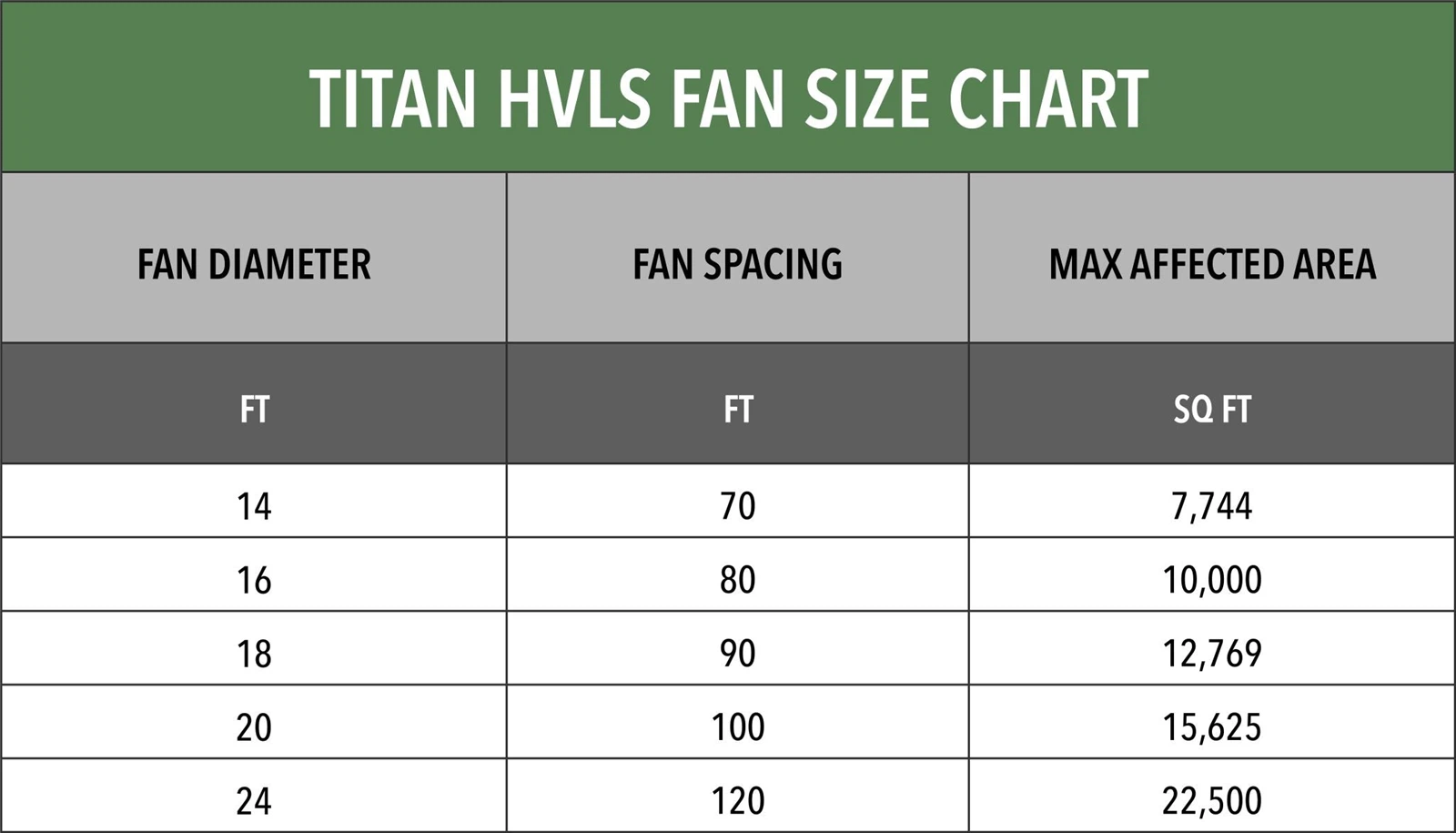
HVLS Fans Size Chart
Check out the following chart to get a better sense of what ceiling fan blade size you'll need and how far apart you'll need to install them to make the best use of your ventilation syst.
HVLS VS. Residential Fans: A Quick Comparison
Size HVLS ceiling fans have a diameter that ranges from 7 feet to a whopping 24 feet. Imagine a fan that can effectively cool an area equivalent to around half a football field! That's what an HVLS fan can do—cool spaces up to 20,000 square feet. This makes them a popular option for expansive warehouses with open bays and high demands of air exchange. HVLS fans can even cool places larger than 40,000 square feet. It's worth noting, though, that for optimal performance, these sizeable fans require a room with a minimum clearance of 10 ft. HVLS fans do indeed occupy a lot of space, but their superior cooling comfort is second to none.Meanwhile, residential fans have a more modest blade span, varying from 3 to 6ft in diameter. These fans are perfectly suited for cozier environments and fit in all the different nooks and crannies of your house. However, the details of your location, such as its size and ceiling height, will ultimately define the exact dimensions of your fan.
Speed It's the speed that sets apart the HVLS models from their residential counterparts. Despite their enormous size, HVLS ceiling fans operate more slowly. Their top speed caps at a moderate 200 revolutions per minute (RPM), with a minimum spin of 71 RPM.Residential fans, on the other hand, may be modest, but they make up for it with their fast pace. They quickly accelerate to a zippy 230 RPM.
Airflow Thanks to their long blades, HVLS fans are the best in terms of airflow. They can move and circulate air well, especially in rooms with high ceilings.Think of their mechanism as creating massive air columns descending to the floor and then billowing outwards in every direction. This creates a natural-like breeze that could drop the temperature by as much as 10 to 12 degrees.Conversely, residential ceiling fans have a unique way of delivering airflow. Instead of the broad, sweeping motions of HVLS fans, they produce swift, fast-moving air directed straight down. Visualize a focused gust of wind that creates a chill effect in the room, making it feel between 8 and 10 degrees colder. One crucial metric in comparing these two fans is the Cubic Feet per Minute (CFM). For instance, a home fan with a 1-hp motor may produce about 29,000 CFM. Compare that to an HVLS fan with the same 1-hp motor, which can churn out a staggering 140,000 CFM. This side-by-side comparison shows how a single HVLS ceiling fan can do the work of multiple similar-powered fans.In the world of fans, size does matter. What matters is the Cubic Feet per Minute (CFM). Hence, the bigger the CFM value, the more robust the performance. Simply put, a fan with a high CFM is a power player, delivering superior performance and efficiency.
Types of HVLS Fans
Direct-drive HVLS Fans
These fans have a motor mounted on the hub of the fan, directly driving the blades. They are generally quieter and more energy-efficient than geared HVLS fans.
Geared HVLS Fans
These fans have a motor that is not directly mounted on the hub but instead uses a gearbox to transfer power to the blades. They have higher torque and can handle heavier loads than direct-drive HVLS fans.
Mixed-Flow HVLS Fans
These fans combine axial and centrifugal fan designs to provide a more efficient airflow. They can be used in a variety of applications, including industrial and commercial environments.
Industrial HVLS Fans
These fans are designed for heavy-duty industrial applications and are typically larger and more powerful than commercial or residential models.
Commercial HVLS Fans
These fans are designed for smaller-scale commercial applications, such as restaurants, retail stores, and office spaces.
Residential HVLS Fans
These fans are designed for home use and are typically smaller and less powerful than commercial or industrial models.
Material of HVLS Fans
Aluminum HVLS fans are lightweight and durable. They are resistant to rust and corrosion, making them ideal for use in environments where moisture is a concern.
Steel HVLS fans are heavier than aluminum fans, but they are also more durable. They can withstand heavy use and abuse without breaking down.
FRP HVLS fans are known for their strength, durability, and resistance to corrosion. They are ideal for use in environments where moisture and humidity are a concern.
Carbon fiber HVLS fans are lightweight and extremely strong. They are ideal for use in environments where weight is a concern, such as in aircraft hangars.
Wooden HVLS fans are stylish and add a natural element to any space. They are ideal for use in indoor spaces, such as restaurants and breweries, where aesthetics are important.
Parts of a HVLS Fans: Decoding Ceiling Fan Anatomy
Mounting Mounting refers to nothing but the fixture that is used to attach the parts of a HVLS fans to the ceiling. There are several mounting mechanisms available in the market. The most commonly used is the ball and socket, as well as the J-hook with a shackle clamp. The ball and socket are used in conjunction with a fan mounting bracket that fits the bottom of the down rod, whereas the J-hook and the shackle clamp parts attach directly to the ceiling. If the mounting is not fitted properly to the ceiling, chances are the fan will fall.
Down Rod The down rod, also known as the suspension rod, is a rigid, galvanised pipe that is used to suspend the HVLS fans from your home's ceiling. The diameter and length of the down rod vary depending on the design and type of ceiling fan. The greater the ceiling fan's down rod length, the lower the ceiling height, and vice versa. One end of the down rod is attached to the motor housing, while the other is attached to the mounting mechanism.
Top and Bottom Canopies There are two canopies located along the suspension rod—top and bottom. The top canopy is mounted in such a way that it covers the bolt, hook, and nut. The bottom canopy, on the other hand, is located under and in the centre of the ceiling fan motor. This canopy is mounted to protect multiple components, such as switches, wires, and capacitors. The bottom canopy is beneficial when ceiling HVLS fans require oiling; you can see the bottom canopy often concealing the oil reservoir, which lubricates the ball bearings.
Ball bearing This is probably the most commonly heard name when it comes to the parts of a HVLS fans. Ceiling fans use ball bearings to ensure noiseless, friction-free movements of rotating components. These are made of high-quality steel and are well-greased for improved fan efficiency and quiet operation.
Electric Motor and Motor Housing The heart of the HVLS fans—the electric motor—converts electrical energy into mechanical energy. As the electrical current passes through the coil of the electric motor, a magnetic field is generated within the coil. This results in the rotation of the coil. This rotational energy is then transferred to the ceiling fan blades, causing them to move. In general, a capacitor is used to generate the necessary phase shift among these currents and is also attached in series with the starting winding.A motor housing refers to a motor cover that is made out of iron. It protects the motor from dust and dirt while also giving the fan a sleek appearance by concealing the inner operation moto.
Blade Bracket A HVLS fans blade bracket refers to the metallic blade hinges that attach the ceiling fan blades to the centre of the ceiling fan. This fan blade bracket is fastened to the ceiling fan blades using bolts or rivets.
Blades One of the most important HVLS fans parts is the blades, which don't just serve an aesthetic purpose but also circulate air around the room. You can consider ceiling fan blades as wings that are attached to the centre of the fan and extend outward. These blades are made using several materials, such as plastic, aluminium, steel, or perhaps even wood.
Applications for HVLS fans
HVLS Fan basics
High-volume low-speed fans are an evolution from the basic industrial ceiling fan. Inspired by airplane wings, HVLS fan blades have been specially designed to move large volumes of air evenly from the center hub all the way to the blade tip. Most manufacturers offer HVLS fan sizes ranging from 8' to 24' in diameter. Despite their large size, most HVLS fan motors are under 2 horsepower. That is why they are a cost effective way to move large volumes of air.
Comfort cooling in the summer
When used to provide comfort cooling for people, an HVLS fan can reduce the perceived temperature by as much as 10 degrees F. This is because the air moving across a person's skin evaporates sweat which causes adiabatic cooling. The velocity of the air determines how much adiabatic cooling occurs and how much cooling effect the person feels. HVLS fans are great for comfort cooling because they can move air at the right velocity to deliver the maximum adiabatic cooling effect over a large area.
There are some things to consider first before installing an HVLS fan for comfort cooling. First, in a non-air conditioned facility, the ventilation system must be sufficient to make the inside temperature the same as the outside temperature. The solar heat load on a building can cause it to be significantly hotter inside and this solar heat load must be removed before installing an HVLS fan. If not, the HVLS fan will be drawing the hottest air from the top of the building and blowing it down on the people below, essentially convection cooking them.
The second thing to consider is that because the HVLS fan provides a cooling effect and doesn't actually change the air temperature, it should be located where its air movement can be felt. Therefore, to get the maximum benefit from an HVLS fan, the ideal location is where there is a high concentration of people.
Lastly, consider using spread and throw calculations to determine the best height for an HVLS fan to distribute air at the right velocity over the largest possible area. In my Spread and Throw blog on January 7, 2020, I provided the method and formulas for calculating spread and throw and how to use them to determine the proper placement of a comfort cooling fan.
Destratification in the winter
The negative attribute of an HVLS fan to potentially convection cook people in the summer becomes a positive attribute in the winter. Because hot air will rise in a heated facility, the air at the top will be warmer than the air at floor level. This is referred to as air temperature stratification. An HVLS fan can effectively be used to move the hot air from the top of the building to floor level resulting in lower costs to heat a facility and greater comfort for people at floor level.
When using an HLVS fan to move hot air to floor level in the winter, the air velocity should be lower than the summertime velocity. This is to reduce the potential for inducing adiabatic cooling which would offset the benefit of moving the warm air to floor level. Therefore, select an HVLS fan that has variable speed settings or is compatible with a VFD to reduce the fan speed in the winter.
Which industries require HVLS fans?
Agriculture
HVLS fans distribute air over a large area, thus keeping the agricultural facility cool throughout the day.
The circulation of air reduces condensation on products and floors.
The efficient air movement also contributes to reducing the energy costs.
With HVLS fans, the temperature between the ceiling and floor remains consistent.
Aviation
By mixing the warmer and cooler air, they minimize ceiling-to-floor differentials.
As a result, the moisture on the floor is reduced, leading to safer conditions in an aircraft hangar.
Fitness clubs
Proper air circulation is important in fitness clubs. Insufficient airflow leads to air pollution which, in turn, causes multiple health issues.
Places with high humidity, stagnant air or limited ventilation may cause Sick Building Syndrome.
The Difference Between Hvls Fans And Household Fans
HVLS fans
HVLS fans are large ceiling fans greater than 7ft in diameter and move a high volume of air at a low speed around 8 mph. Originally designed for large spaces like factories and warehouses, HVLS fans have improved due to advancements in technology and can now be found in a wide variety of industrial, commercial and even residential spaces.
In comparison, residential fans are smaller in size and are high-velocity ceiling fans that create small turbulent air streams. They are mostly used in homes to provide cooling comfort in bedrooms, living rooms, dining rooms and more.
Let's look at the key differences and benefits between HVLS and residential fans to help you determine the right fan for your space.When comparing which fan type will meet your particular needs, the major differences to consider between HVLS and residential fans are size, speed, and the direction of airflow.
Size
Typically, HVLS fans can be as small as 7ft to as large as 24ft in diameter and can cover an area of over 20,000 square feet. They are frequently used to cool spaces with more than 40,000 square feet and are an ideal solution for warehouses with open bays and frequent air exchange. HVLS fans require a minimum clearance of 10 ft to ensure adequate space.
Residential fans range in blade span and can be anywhere from 3ft to 6ft in diameter. They are generally used in smaller spaces, but the size and ceiling height of your space will determine the exact size of fan you will need.
Speed
HVLS fans spin at a relatively low speed compared to residential fans. HVLS fans can reach a maximum speed of 200 RPM (revolutions per minute) and a minimum speed of 71 RPM. While a residential fan spins at a higher speed up to 230 RPM.
Airflow
Airflow is the biggest differentiator between residential and HVLS fans.
HVLS fans move more air providing complete air circulation throughout large, high ceiling spaces due to their long blades. They produce air columns that move towards the floor and are then pushed outward in a 360-degree direction throughout the workspace. The airflow created feels like a natural breeze, making it feel 10 to 12 degrees cooler.
In contrast, residential ceiling fans move air quickly and at a high speed in a concentrated downward motion. They also create a wind-chill effect making it feel 8 to 10 degrees cooler in a room.
The measurement to consider when comparing airflow is cubic feet per minute (CFM). This indicates the volume of air moving through the fan each minute. Residential fans can produce around 29,000 CFM with a 1-hp motor, whereas a HVLS fan can produce around 140,000 CFM with the same 1-hp motor. This comparison demonstrates how a single HVLS fan can replace several fans of similar total horsepower.
The higher a fan's CFM number, the higher the fan's volume or capacity. The higher the volume, the better the performance.
Our Factory
At present, OPTFAN is one of the few professional manufacturers in the HVLS industry fans field with R & D team,manufacturing, program consultation, installation , sales and after sale service as one. It has the most experienced team to provide one-stop service.
OPTFAN's commitment to quality, craftsmanship and innovation to introduce unique new products is why they remain unrivaled today and why OPTFAN last for generations.They have never stopped pushing the boundaries of what's possible when it comes to engineering and product development.


Company Honor
CE、TUV、ISO、ERP、CQC

Asked Questions
As one of the leading hvls fans manufacturers and suppliers in China, we warmly welcome you to buy or wholesale hvls fans made in China here from our factory. All customized products are with high quality and competitive price.
HVLS Large Industrial DC Fan, Gearbox HVLS Fan, HVLS Mobile Fans